


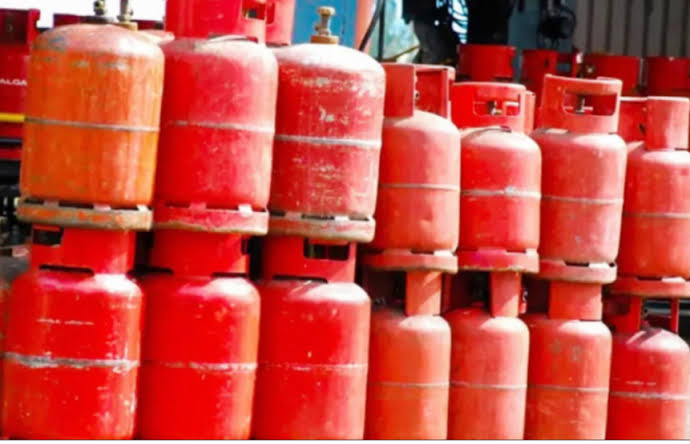
Nigerians are lamenting over the scarcity of Liquified Petroleum Gas, LPG, popular as Cooking Gas and the astronomical increase of the product from N1050 per KG to N1800 per KG.
It has increased by 34.6 percent on a Week-on-Week basis, to N18,500 this week, from N13,150 for 12.5KG the previous week.
Nigerians are however complaining about the scarcity and high prices of cooking gas, which are driven by factors like increased import dependence, poor distribution infrastructure, and a weakened naira.
The situation has led to lifestyle changes, with some households reverting to less healthy cooking methods like firewood, despite government efforts to boost domestic supply.
The rising prices is presently causing financial strain for many households and small businesses.
Checks has confirmed that the price of 1KG currently retails at N1,750, N1,800 and N2,000 depending on the location.
Major depots in Alimosho Local Government Area of Lagos State have close shops as they complain of non availability of the product as they are unable to get from the Gas Farm.
Most vendors in Ogun State that opened shops in some neighbourhoods jacked up the price by selling at N1,600 per kilogram instead of N1,150 per KG as sold last week.
Adejoke Ibikunle, said there was a long quene for cooking gas in one of the gas stations in Ibafo, Ogun State despite the fact that it was sold for N1,500.
Lamenting the situation, Joke Banjo, a trader at Agege, said she was searching everywhere to refill her 12kg cylinder, but could not find any until she got to Ojodu.
She said she managed to refill her 6kg cylinder before the station stopped selling due to long queue.
She expressed displeasure over the issue, wondering what would have happened to the supply of cooking gas.
The non availability and scarcity of the product and the increase in the price of the product according to Olatunbosun Oladapo, the National President of the Nigerian Association of Liquefied Petroleum Gas Marketers, “the recent increase was a as a result of the industrial action by the Petroleum and Natural Gas Senior Staff Association of Nigeria, PENGASSAN, adding that it affected the supply value chain majorly in the South-West”.
He further noted that Gas is majorly a business of demand and supply, when there is limited supply of the product, the demand would be high, thereby result to hike in price.
Oladapo added that, “As at the time PENGASSAN embarked on the strike, all gas plants were shutdown, most gas plants have limited supply. Dangote, our major supplier in terms of availability and affordability of the product, is yet to release loading invoice to our members who have pending products with the company for more than three weeks forcing marketers to buy from other competitors at a high rate.

“Other competitors, took advantage of the challenges most of our marketers are facing with Dangote and also the industrial action to increase their price.
“No marketer will want want to leave his plant empty, therefore, they buy from these competitors.
“We appeal to Dangote to truck out product to more marketers as this will enhance the supply. We are hopeful the price will drop in the coming weeks,” he added.
According to Energy expert, Tunde Mukthar,
“Nigeria relies heavily on imports for cooking gas, making its price vulnerable to international inflation and exchange rate fluctuations”.
Mukthar added that the inefficient distribution networks and high transportation costs, particularly to rural areas, increase the final price for consumers, leading to the astronomical increase of the product.
He added that the weakening value of the Nigerian naira against other currencies increases the cost of imported gas and related expenses like freight and insurance.
Meanwhile, energy industry analyst, Yemisi Olagunju, has also raised the alarm that Nigeria may be on the verge of a domestic LPG supply crunch.
Speaking during the 2025 National LPG Conference and Exhibition in Lagos, Olagunju insisted that the minister’s directive must be enforced to stop the outflow of LPG from Nigeria.
“The domestic market does not have sufficient volumes of gas, so there is no justification for exporting the product out of the country by the IOCs”, Olagunju stated.
He said IOCs have consistently argued that they lack the facilities to separate propane from butane, a requirement for making the product more suitable for domestic use.
She stated that these companies had previously requested a timeframe to put such facilities in place, yet there has been no enforcement or monitoring by government agencies to ensure compliance.
“Companies prefer to export these products abroad to make more money,” he said, stressing that the practice undermines Nigeria’s domestic LPG market, which still struggles with insufficient supply.
She urged the Nigerian Midstream and Downstream Petroleum Regulatory Authority (NMDPRA) and the Minister of State for Gas to compel the IOCs to establish the required infrastructure for propane-butane separation.
It would be recalled that the FG place a ban on gas exports, that waa announced in 2024 to boost domestic availability, but many Nigerians report that the intended price relief has not been realized.





Recent Comments