


……Massive Reshuffling Looms
For years now, insecurity has been a menace in Zamfara State, with the worrisome situation yet to abate, leading to political upheaval.
The State is however enmeshed in crisis following the emergence of a leaked memorandum purportedly implicating Senior Government Officials, including the Governor of the State, Dauda Lawal, of financing terrorism and banditry in the State.
This development, it was gathered has generated widespread indignation and outrage, both domestically and internationally, indicating that there would be an unprecedented and abrupt reshuffling of key Civil Servants across the state, in a move that has sent shockwaves through the bureaucracy.
It is been gathered from Sources within the Zamfara State Government House that the Governor was visibly incensed upon learning of the leaked memo, which allegedly detailed financial transactions facilitating banditry and further entangling high-ranking government officials in the scandal.
At the epicenter of the Governor’s anger was reportedly the Commissioner of Finance, who, as the overseer of the state’s financial management, is responsible for orchestrating the movement of accounting staff within the bureaucracy.
There are however moves to mitigate the fallout from the public embarrassment and intense backlash from international human rights organizations, Governor Lawal has swiftly initiated a comprehensive reorganization of civil servants within the state bureaucracy, specifically focusing on the treasury department.
This strategic it was disclosed was formally communicated through a subsequent memo, meticulously outlining the extensive reshuffling of civil servants.
According to credible sources, the Governor’s office, in an unconventional and unexpected maneuver, sidestepped the Commissioner for Finance and instead entrusted the Head of Service, Ahmad Aliyu Liman, with the sensitive task of orchestrating the “special” redeployment of treasury staff.
This unusual deviation from established protocol has raised eyebrows, sparking speculation about the motivations behind this decision and the extent of the Governor’s involvement in the treasury department’s affairs.
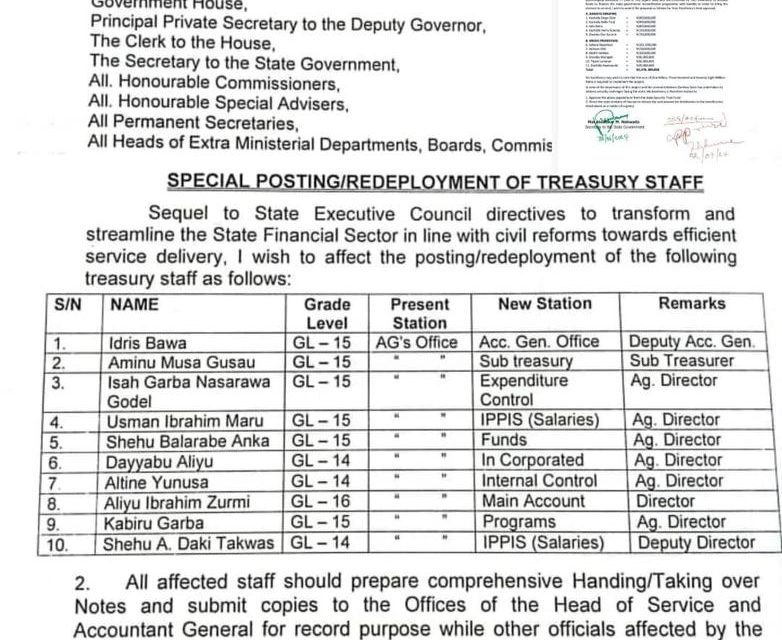
The follow-up memo with the reference number HOS/Z/844/VOL.III, outlines the redeployment of various senior treasury staff, including directors and deputy directors in key financial departments.
Here are some of the notable redeployments:
-Idris Bawa (GL-15): Moved from the Accountant General’s Office to a new post in the same office.
Aminu Musa Gusau (GL-15): Shifted from the Sub-Treasury to become the Deputy Accountant General.
Isah Garba Nasarawa Godel (GL-15): Appointed Acting Director of Expenditure Control.
Shehu Balarabe Anka (GL-15): Moved to the IPPIS (Salaries) department as Acting Director of Funds.
The comprehensive reshuffling affected over a dozen senior civil servants, many of whom held critical positions in the state’s financial management and control systems.
Government sources claimed that these postings are part of a broader move to sanitize the state’s financial sector in line with civil service reforms. However, the sudden nature of the redeployment raises questions about its true intent.
The Commissioner of Finance, typically entrusted with overseeing the assignment of accounting staff within the state bureaucracy, was conspicuously bypassed in this reshuffling exercise.
According to well-placed sources, this decision stemmed from a profound lack of confidence in his office, coupled with deep-seated concerns that sensitive documents may continue to surface in the media.
The strategic redeployment of key financial personnel coincides with escalating suspicions that the Governor’s office is endeavoring to conceal the damning allegations outlined in the initial leaked memo.

While the government asserts that these personnel changes constitute part of comprehensive financial sector reforms, critics vehemently argue that the Governor’s true intention is to insulate himself from intensified scrutiny. The timing of this reshuffling has also raised significant concerns. If, as the Governor’s office maintains, the initial allegations of financial support to bandit leaders were entirely fabricated, it beggars the question: why the apparent haste to reassign key staff and prevent further leaks?
The emergence of the leaked documents has galvanized international and local organizations to demand a thorough, impartial investigation into the state’s financial dealings.
For years, Zamfara State has been labeled with a Dark Web of Terrorism Links, and this has intensified with the surfacing of fresh allegations linking Governor Lawal to Farouq Abdulmutallab, the infamous perpetrator of the 2009 ”ailed terrorist attack.
Although the specifics of this purported link remain unsubstantiated, the mere mention of Abdulmutallab’s name in conjunction with Zamfara’s escalating crisis has significantly exacerbated suspicions of the Governor’s involvement in terrorism financing.
Local leaders and astute political observers are gravely concerned that should these allegations be validated, Zamfara, already a volatile hotbed of banditry and insecurity, may descend into even greater instability.
The confluence of events – the leak of sensitive documents, the ensuing reshuffling of key personnel, and the Governor’s alleged ties to global terrorism – raises profoundly disturbing questions about the quality of governance and security apparatus in the state.
Political analysts are of the opinion that the potential implications of these allegations are far-reaching, threatening to undermine the fragile stability of the region and perpetuate an environment conducive to terrorist activities.
The conspicuous silence and his failure to issue an official statement addressing the leaked memo or the recent reshuffling has raised different posers, with various insinuations from different quartees surfacing.
As pressure continues to intensify from diverse quarters, with numerous voices demanding the Governor’s immediate resignation and a comprehensive, impartial investigation into the financial transactions of the Zamfara State Government, the Governor has remained defiant in constituting an independent investigative Committee to address the issue.
This development has raised several Unanswered Questions whether
the initial memo alleging the Governor’s collusion with bandit leaders was indeed fabricated or tampered with, and why the abrupt shift in focus towards preventing government document leaks, implicitly acknowledging the veracity of the prior accusations?
The swift reshuffling of civil servants and the deliberate bypassing of the Commissioner of Finance in this process has put the state in palpable panic and desperation, suggesting a frantic endeavor to reassert control and contain potential damage.
This sudden and drastic action raises more questions than answers, casting doubt on the Governor’s professed innocence and fueling speculation about his actual involvement in the allegations.
The haste with which the Governor’s office has moved to reorganize key personnel and sidestep established protocols implies a profound sense of vulnerability, underscoring the likelihood that the initial memo struck closer to truth than initially acknowledged.
No doubt, Governor Lawal stands at a precarious juncture, faced with a daunting decision that will determine the fate of his administration and the state’s role in combating terrorism.
The recent reshuffling, ostensibly presented as a facet of civil service reform, appears to be a strategic maneuver aimed at mitigating the fallout from the damning allegations contained in the leaked memo.
As clamors for accountability intensify, both domestically and internationally, the leadership of Zamfara State teeters on the brink of collapse, its credibility severely compromised.






Recent Comments